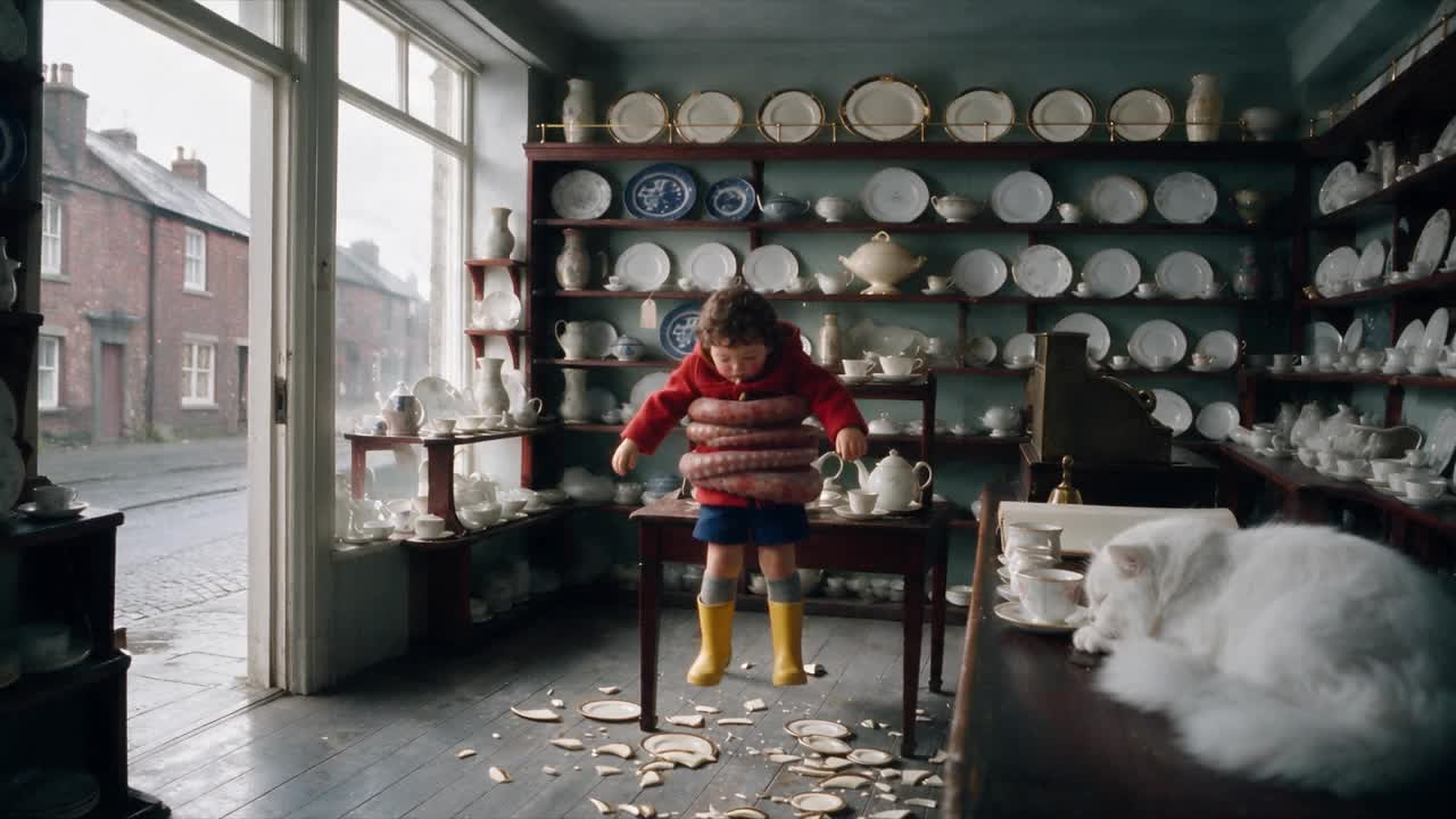
Episode two of Handle With Care took twenty-five goes to produce ninety seconds of film. Six of them are in the finished thing. The other nineteen are the interesting part.
These are the notes from that build. The rules I pulled out of it live in the short film guide, which is what to read if you want the method. This is the list of what went wrong.
One thing worth saying first, because it changes how to read the rest. I direct and Claude operates. I decide what a scene is and whether a clip works. Claude sets up the workflow, sends the generations and runs the checks, plugged into WunderNode directly.
Where the attempts went
| Scene | Attempts | What finally fixed it |
|---|---|---|
| Opening scene | 5 | Making a photo of the set instead of describing it in words |
| Voice tests | 2 | Nothing. They disproved two theories of mine |
| Scene 1, browsing | 5 | A set photo with the doorway in the correct wall |
| Scene 2, climbing | 3 | Giving the octopus wheels so he could physically get there |
| Scene 3, the catch | 5 | Two camera positions instead of one, and no slow motion |
| Scene 3, split in two | 2 | Starting the second half on the last frame of the first |
| Closing scene | 1 | All the mistakes happened in still pictures first |
| Stray fragments | 2 | Written before the scene around them existed |
Look at the closing scene. One video generation, and not because it was an easy scene. It was the hardest set-up in the episode. I just made all the mistakes in still pictures first, where they come back in seconds instead of minutes, so by the time I asked for video there was nothing left to get wrong.
Then look at the stray fragments. Two clips of seven seconds each, generated before I had written the scene they belonged to, and both useless the moment I did.
The door that was never there
Scene 1 opens with Maud at the shop door signing for a delivery. I made a photo of the set for it, checked it against the photo I had made before it, and shot the scene.
There is no door on that wall. Episode one’s wide shot looks down the length of the room, and the only angle that ever sees the door faces the front of the shop. I had invented one, carried it into the next photo, then widened it into a floor-to-ceiling gap that quietly deleted a whole dresser of china to make room.
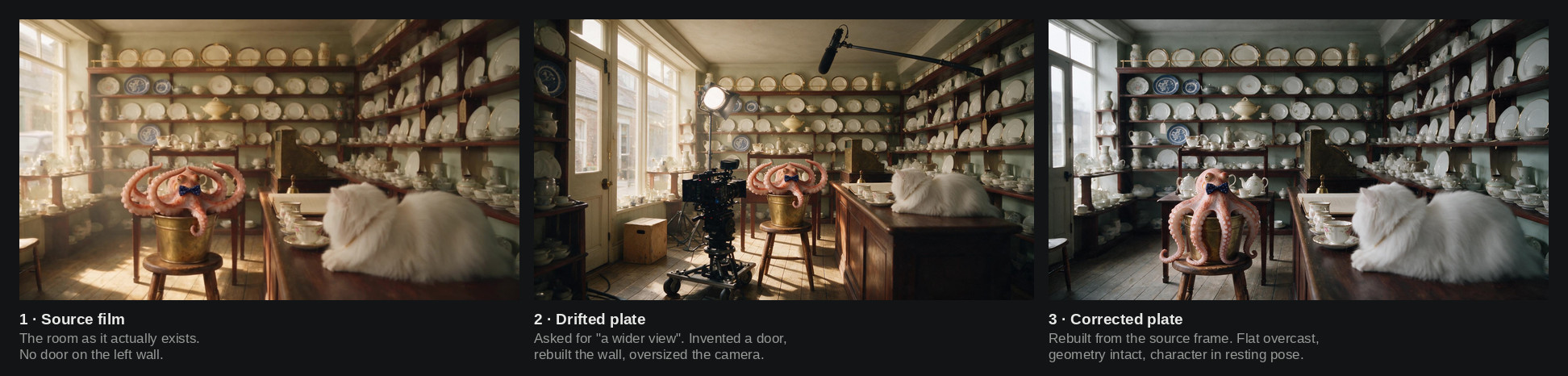
The middle one is perfectly convincing on its own. Put it next to the real thing and it is a different building.
Three pictures, each checked against the one before it, all three wrong against the actual film. Four of the five attempts at Scene 1 came back to this rather than to anything I had written in the prompt. Now I hold every new picture up against the real footage instead of against the last thing I made.
Otto had no life in him
My first prompts for Scene 2 told the octopus that his face stays still and his arms do not move. I was trying to stop him waving at the camera. What I got was furniture wearing a bow tie.
So I over-corrected, and he fidgeted through the whole next attempt like he needed the toilet. The version that worked is tiny. He breathes, his eyes follow whatever is moving, and his colour flushes at exactly two moments in the episode that have earned it. Everything else stays still.
The lesson turned out to apply everywhere. Naming one thing that moves is a rule for objects. Point it at a person and you get a shop dummy.
The catch was physically impossible, and that was my fault
In Scene 3 a four-year-old comes off the top of the shelving and Otto catches him.
Otto lives in a brass bucket on a stool in the middle of the floor. The shelving is against the back wall. For three attempts I asked for a catch that no arrangement of arms could actually make, and the model gave me exactly what I asked for, which looked like an octopus teleporting.
The fix was in Scene 2, not Scene 3. I put wheels on the stool and rolled him over to the foot of the shelves during the chase, so by the time the boy falls he is already standing underneath him. It also improves the earlier scene, because now all his fussing has somewhere to go.
You could not see the thing the whole episode was about
Then I got a version where the catch happened and I could not actually see it.
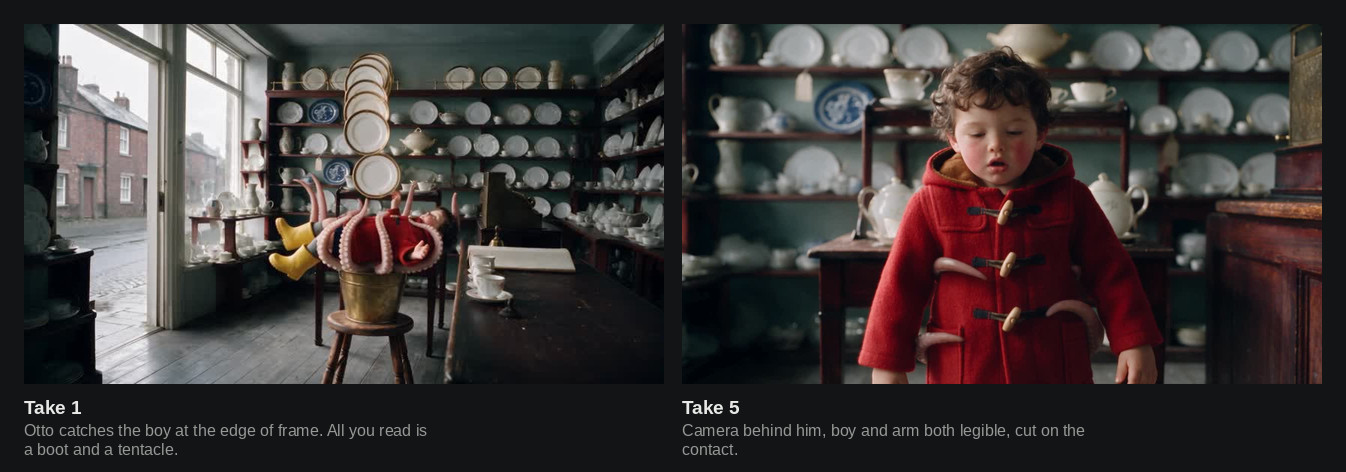
My shot list was a list of events. Boy falls, plates fall, boy is caught, Maud comes in. Nowhere in it was a single shot of the character the whole episode is about, doing the thing the whole episode was built for. One attempt cut straight from the falling plates to an empty floor of broken china.
What fixed it was choosing two camera positions and staying with them. One behind him looking past his shoulder at the boy, one turned round onto his face, plus a shot of him deciding to let the china go. Cut between those three and the catch finally reads.
Slow motion never once helped
I tried eleven seconds of slow motion across the fall. Then two seconds, just on the moment of impact. Both were worse than playing it straight.
Slow motion in this model comes out like syrup rather than tension. The version that works runs at normal speed with a cut about every second, and the whole fall is over in four. If you want a moment to feel dangerous, cut it faster.
One failure I never explained
On one Scene 1 attempt, Otto delivered his line in Maud’s voice.
Everything was set up correctly. The voice samples were attached in the right order and pointed at on every line of dialogue. Between us we came up with two confident explanations and then disproved both of them with tests. Then I ran it again, it was fine, and it has not happened since.
I am including it because write-ups like this tend to end every problem with a neat explanation, and sometimes it is one bad roll of the dice. The trap is bolting a new instruction onto your prompt after every failure until you are running six hundred words of scar tissue that fights itself. Run it again once before you rebuild anything.
What changed for the whole series
Golden hour is gone. Episode one was lit with hard morning sun turning into warm amber evening. Honeyed slanting light, haze, floating dust and glowing windows are together the most recognisable AI-picture signature there is, and I had baked it into every reference I owned. Episode two is flat grey daylight all the way through. It suits the comedy better anyway. The jokes are all dry, and dry jokes play badly in romantic light.
The dialogue got cut nearly in half. Episode one had eighteen lines in two minutes, and somebody on Reddit said the voices and rhythm sounded like every viral AI video going. They were right. Episode two has ten lines in ninety seconds, five of them under five words, and it plays better.
Nothing breaking on screen turned out to be a habit rather than a law. It held for one whole episode and got spent deliberately in this one to save a child. It does not reset either, which raises the stakes on every near miss from here.
What I would tell someone starting episode one
Make your reference pictures before the story tempts you into shooting anything. Rough everything out at low quality until the cuts, the weight and the performances all hold together, then generate the good version once. And keep a frame from every scene you approve, because that frame is what keeps the next scene looking the same, and the voices in it are the ones every later scene copies.
The full method is in the guide. The workflow this episode came out of is published as the Short Film Workflow template, notes and all, if you would rather start from something that already runs.
Sign up for WunderNode if you don’t have an account yet. It takes about a minute.